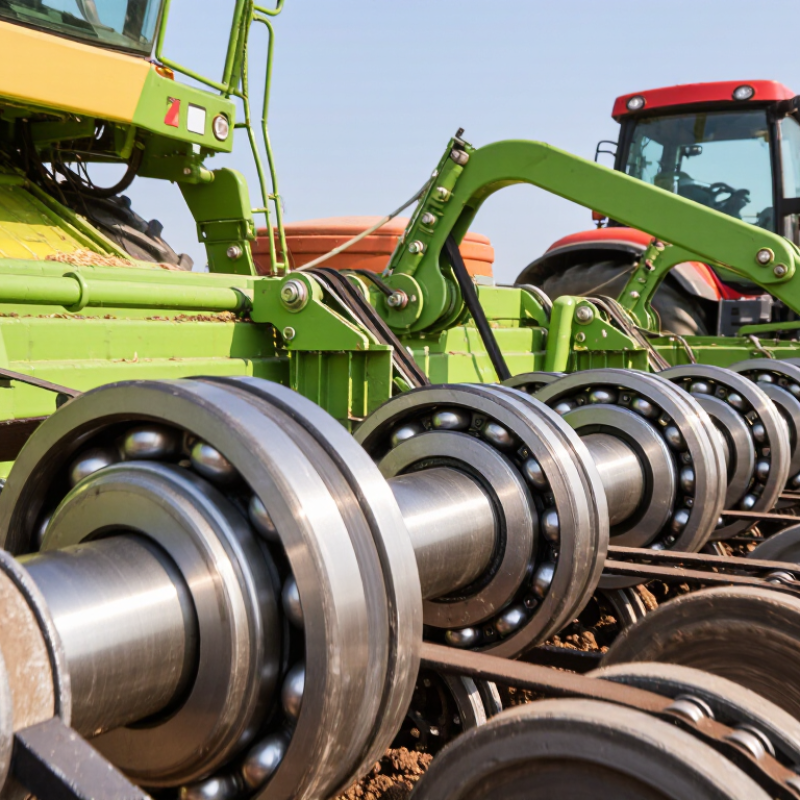
Farm equipment works in conditions that ordinary industrial machinery rarely faces. Dust enters housings, mud clings to shafts, and vibration travels through frames during long harvesting days. Agricultural Bearings are designed for these demanding environments, supporting rotating parts in combines, tractors, planters, balers, and irrigation systems.
Their value extends beyond simple rotation. Properly selected bearings can manage heavy radial loads, sudden impacts, moisture, and contaminated grease. Seals help reduce the entry of soil and water, while suitable materials and clearances support reliable operation across changing temperatures. The difference is measurable. Less friction can reduce energy loss, heat buildup, and unexpected stoppages during critical fieldwork.
However, no bearing is magic. A premium component may fail quickly if the shaft is misaligned, lubrication is neglected, or the load exceeds its rating. That assumption needs checking. Experienced technicians usually examine operating speed, housing design, contamination levels, and maintenance history before selecting a bearing. Manufacturer specifications and recognized engineering practices should guide that decision, not price alone.
In practical terms, a farmer may notice the result as a quieter conveyor, a steadier planter disc, or fewer interruptions beside a full grain hopper. These small improvements can protect schedules and reduce repair costs. Still, performance depends on the complete system. Agricultural Bearings work best when installation, sealing, lubrication, and inspection receive equal attention. Choosing them is not merely a parts decision; it is a reliability decision shaped by real field conditions.
Agricultural bearings are mechanical components that help farm equipment rotate smoothly under demanding conditions. They support shafts in plows, seeders, harvesters, conveyors, and other machinery. Unlike standard industrial bearings, agricultural types often face dust, mud, moisture, vibration, and sudden impact. Their seals and housings help protect rolling elements from contamination. Proper bearings also reduce friction, control shaft movement, and transfer working loads safely. When a disc harrow enters hard soil, the bearings absorb forces that would otherwise damage the shaft or frame.
Choosing the correct bearing requires more than matching a diameter. Technicians should check load direction, operating speed, shaft size, mounting space, sealing quality, and lubrication needs. Field maintenance also matters. A bearing may be technically suitable but fail early because it was installed crookedly or over-tightened. Moisture is often underestimated. Regular inspections can reveal unusual noise, heat, looseness, or grease leakage before a breakdown stops work. Recognized bearing specifications and equipment manuals should guide the final choice. Even experienced operators can miss a small alignment problem.
Tips: Clean the shaft before installation. Use the recommended lubricant and avoid mixing grease types without confirmation. Check seals after pressure washing. Rotate the shaft by hand after fitting. It should move smoothly, not roughly. Keep records of operating hours and replacement conditions. These details expose patterns, although maintenance records are sometimes incomplete. That gap deserves attention.
Agricultural bearings are built for fields where dust, moisture, vibration, and uneven loads are normal. Their sealed construction helps keep soil particles away from rolling surfaces. This matters when a planter crosses dry ground or a harvester works after rain. Reliable seals also reduce grease loss during long operating hours.
Corrosion resistance is another important feature. Fertilizer residue and muddy water can attack exposed metal quickly. Suitable agricultural bearings use protective finishes and materials designed for harsh outdoor contact. Strong cages and rolling elements manage repeated shock from rough tracks. They also tolerate limited shaft misalignment, which can occur when frames flex under load.
Small details affect service life. Correct clearance allows the bearing to handle heat and changing loads. Grease must match the operating speed, temperature, and contamination level. Too much grease can create heat, while too little leaves surfaces unprotected. No bearing is maintenance-free.
Regular inspection remains necessary. Listen for grinding, check unusual play, and look for darkened grease or damaged seals. A bearing may appear acceptable but fail after several hours in the field. Installation also deserves care; hammering the wrong ring can damage internal raceways before operation begins. Field conditions are rarely consistent, so bearing selection should reflect the machine, load, speed, and maintenance schedule.
Agricultural bearings help farm equipment perform reliably under demanding conditions. They support rotating shafts in combines, planters, balers, and irrigation systems. These machines face dust, moisture, vibration, heavy loads, and long operating hours. Suitable bearings reduce friction and help maintain steady shaft movement. That means smoother power transfer and less wasted energy. Small improvements matter during a narrow harvesting window.
In field service, bearing failures often begin quietly. A slight rumble, rising temperature, or uneven vibration may signal trouble. Sealed designs help keep out soil and crop residue. Strong housings also protect internal components from impacts and misalignment. However, agricultural bearings are not a cure for poor installation. Excessive tightening, incorrect lubrication, or a bent shaft can shorten service life quickly. I have seen clean new bearings fail because surrounding parts were ignored.
Tips: Check bearing temperature during routine stops. Listen for changes in sound. Keep grease clean and use the recommended amount. Inspect seals after pressure washing. Record unusual vibration before it becomes a breakdown. A simple maintenance log can reveal repeated problems. It may also expose an overlooked issue: operating conditions change throughout the season. Selection should consider load, speed, contamination, and mounting accuracy. Reliable performance comes from matching the bearing to the machine, then maintaining both carefully. Even good equipment needs attention.
Agricultural bearings face dust, moisture, shock loads, and long working hours. In field inspections, I often see failure begin around a seal, not the rolling elements. Dust changes everything. USDA’s 2022 Census of Agriculture recorded 1,900,487 farms in the United States, reflecting the wide range of equipment and operating conditions that bearings must support.
Deep-groove ball bearings suit conveyors, electric motors, and lighter rotating assemblies. They handle radial loads well and tolerate moderate speed. Tapered roller bearings fit wheel hubs and heavy shafts because they manage combined radial and axial loads. Spherical roller bearings work better where shafts flex or frames become slightly misaligned. Needle roller bearings offer high load capacity in compact spaces, especially around pivots and transmissions. Mounted insert bearings simplify replacement on exposed shafts, although their housings still need careful alignment.
Seal design matters as much as bearing type. Labelling alone cannot protect a bearing from crop residue. FAO’s 2022 report on agricultural automation emphasizes that equipment reliability affects productivity and access, especially for smaller farms. ISO 281 also shows why dynamic load rating and equivalent load belong in the selection process. A larger bearing is not automatically safer. Not always. Excess clearance can create vibration, while excessive grease can raise operating temperature. I have made that assumption before, and the inspection results were uncomfortable. Fit matters. Regular checks should examine heat, noise, shaft play, and seal damage before planting or harvest begins.
Agricultural bearings are designed to handle dust, moisture, vibration, shock loads, and frequent washing. The chart compares common bearing types used in farm equipment by their typical suitability for three important operating requirements. Scores range from 1 to 5, with 5 representing stronger suitability.
Insert bearings are widely selected for mounted units because they are easy to install and commonly available with protective seals. Spherical roller bearings are suitable for heavy loads and shaft misalignment, while tapered roller bearings are preferred where combined radial and axial loads occur. Deep groove ball bearings support high-speed rotation, and needle roller bearings are useful where compact radial-load solutions are required.
Agricultural bearings support harvesters, planters, balers, and irrigation equipment in harsh working conditions. Dust, mud, water, vibration, and uneven loads can quickly expose a weak selection. Choosing the correct bearing starts with the machine’s actual duty cycle, not only its catalog size.
Check radial load, axial load, operating speed, and shaft dimensions carefully. A bearing may fit physically but fail under repeated shock loads. Sealed designs help block dust and moisture near planting or harvesting areas. However, seals can increase friction and temperature at high speeds. That trade-off deserves attention.
Select grease that matches the working temperature, load, and contamination level. Over-greasing can create heat, while insufficient grease accelerates wear. Inspect the shaft and housing before installation. Scratches, looseness, or misalignment can damage a new bearing quickly. Corrosion-resistant materials may help near fertilizer, washing systems, or frequent rain.
Field technicians often find that maintenance access influences bearing life as much as bearing capacity. Choose a design that workers can inspect, lubricate, and replace safely. Also consider expected service hours and seasonal storage conditions. A machine stored with moisture inside can develop rust before its next season. No selection is perfect. Recheck assumptions after observing noise, heat, vibration, and wear in real operation.