| Top Steel Bearing Types for Global Buyers |
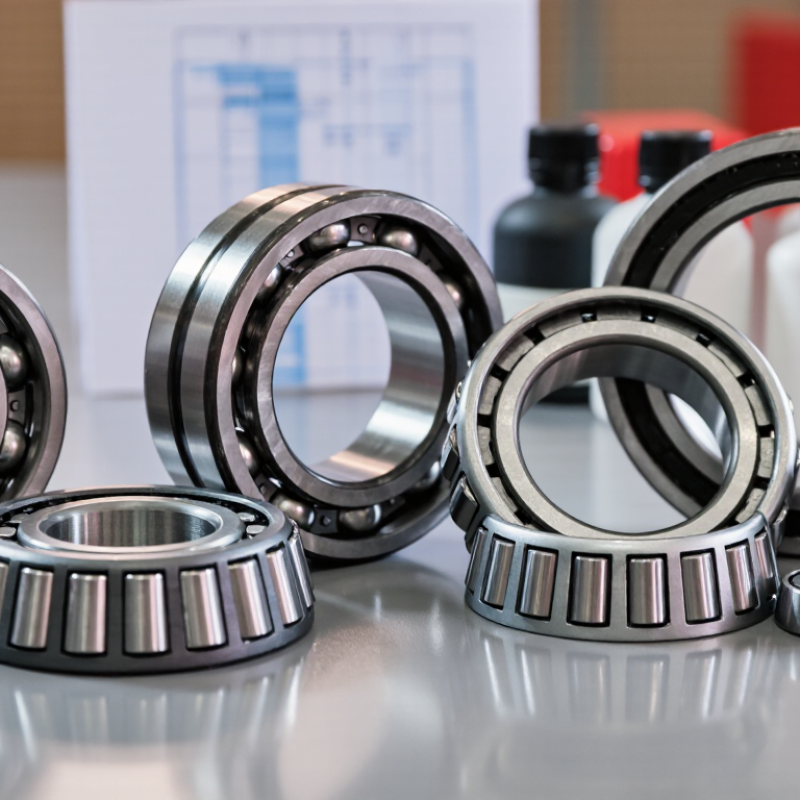
| Deep-Groove Ball Bearings |
Through-hardened bearing steel, commonly equivalent to 100Cr6 or AISI 52100; stainless variants commonly use AISI 440C-type steel. |
Radial loads and moderate axial loads in both directions. |
Electric motors, pumps, fans, gearboxes, conveyors, machine tools, and general industrial equipment. |
Low friction, high speed capability, compact design, widely standardized dimensions, and broad availability. |
Less suitable for heavy shock loads, major shaft misalignment, or severe contamination without suitable seals. |
Bore and outside diameter, width, clearance class, seal or shield configuration, cage material, accuracy class, noise level, and grease selection. |
| Angular-Contact Ball Bearings |
Through-hardened chrome bearing steel; stainless steel options are used where corrosion resistance is required. |
Combined radial and axial loads; axial capacity depends on contact angle and arrangement. |
Machine-tool spindles, pumps, compressors, screw drives, robotics, and precision rotating assemblies. |
Supports axial loads at high speed and can be arranged back-to-back, face-to-face, or in tandem. |
Requires correct mounting orientation, preload control, and accurate shaft and housing geometry. |
Contact angle, preload, duplex arrangement, axial load direction, speed rating, runout, matched-set requirements, and lubrication. |
| Cylindrical Roller Bearings |
Case-carburized or through-hardened bearing steel; roller and raceway hardness must be controlled for fatigue resistance. |
High radial loads; selected designs can accommodate limited axial displacement or axial loads. |
Gearboxes, electric motors, generators, traction systems, compressors, and heavy industrial machinery. |
High radial load capacity, high radial stiffness, and good performance under heavy-duty conditions. |
Most configurations have limited axial capacity and require careful control of alignment and internal clearance. |
Internal design, flange arrangement, radial clearance, roller guidance, limiting speed, load spectrum, and mounting tolerances. |
| Tapered Roller Bearings |
Through-hardened or case-carburized bearing steel, often selected for high contact stress and shock-load resistance. |
Combined radial and axial loads; axial capacity increases with the effective contact angle. |
Vehicle wheel ends, transmissions, industrial gear drives, construction equipment, and heavy-duty shafts. |
High combined-load capacity, adjustable axial clearance, and good resistance to shock and impact loading. |
Usually requires paired installation, correct preload or endplay adjustment, and periodic inspection in demanding service. |
Cup and cone dimensions, contact angle, preload or endplay, pair matching, hardness, surface finish, and sealing arrangement. |
| Spherical Roller Bearings |
Through-hardened bearing steel; case-hardened components may be specified for severe impact or contamination conditions. |
Very high radial loads with substantial axial load capability, depending on the internal design. |
Mining equipment, crushers, conveyors, paper machinery, fans, steel-processing equipment, and large gearboxes. |
Accommodates shaft and housing misalignment while carrying heavy radial loads. |
Larger radial section, higher friction than many ball-bearing designs, and greater sensitivity to lubrication quality. |
Permissible misalignment, radial clearance, adapter or withdrawal sleeve, load rating, seal design, lubrication method, and housing stiffness. |
| Needle Roller Bearings |
High-carbon bearing steel for rollers and races; drawn-cup designs commonly use hardened thin-wall steel shells. |
High radial load capacity for a small radial cross-section; axial capacity is generally limited unless additional thrust elements are included. |
Automotive transmissions, planetary gears, universal joints, pumps, compressors, and compact mechanisms. |
Small radial envelope, high load density, and good suitability for space-constrained assemblies. |
Requires a suitable raceway, good shaft hardness and surface finish, and accurate alignment. |
Inscribed circle diameter, roller length, raceway hardness, shaft surface finish, radial clearance, lubrication, and allowable misalignment. |
| Thrust Ball Bearings |
Through-hardened bearing steel; stainless steel is available for selected corrosive environments. |
Primarily axial loads in one or both directions, depending on the design; radial loads are generally limited. |
Vertical shafts, screw mechanisms, turntables, low-to-moderate-speed indexing systems, and axial positioning assemblies. |
Simple axial-load solution, compact axial design, and easy separation for some configurations. |
Not intended for significant radial loads, shaft misalignment, or high-speed operation without appropriate design review. |
Single- or double-direction design, axial load, speed, shaft and housing washer fit, lubrication, and mounting orientation. |
| Four-Point Contact Ball Bearings |
Through-hardened bearing steel; special heat treatment may be specified for high-load or high-reliability applications. |
Combined radial and axial loads, including axial loads in both directions; moment capacity depends on the assembly. |
Robotics, slewing mechanisms, indexing tables, aerospace-type actuation systems, and compact gear arrangements. |
Can replace paired angular-contact bearings in selected arrangements and provides a separable inner or outer ring in many designs. |
Requires accurate load and moment analysis; ball skidding and raceway stress must be checked at low or oscillating speed. |
Contact angle, four-point geometry, axial and moment loads, operating speed, preload, split-ring configuration, and lubrication. |
| Quality Standards and Verification Criteria |
| Dimensional and Running Accuracy |
Use ISO 199 for bearing boundary dimensions and ISO 492 for radial bearings or ISO 199-1-related requirements where applicable. Common accuracy classes include Normal, P6, P5, P4, and higher precision grades for suitable products. |
Accuracy class should match the shaft speed, vibration requirement, radial runout, axial runout, and equipment precision. |
Request dimensional inspection records, radial runout results, axial runout results, and lot traceability rather than relying only on a grade label. |
| Load Rating and Fatigue Life |
Calculate dynamic load rating and basic rating life using ISO 281 principles. Static load capacity should be checked separately for shock, impact, or stationary loads. |
Life calculations should include actual load spectrum, speed, temperature, lubrication, contamination, misalignment, and installation conditions. |
Ask for the calculated dynamic and static load ratings, reference life method, reliability target, and assumptions used in the calculation. |
| Material and Heat Treatment |
Common steel categories include high-carbon chromium bearing steel, case-carburized bearing steel, and corrosion-resistant martensitic stainless steel. |
Important controls include chemical composition, hardening depth, core hardness, surface hardness, retained austenite, dimensional stability, and distortion. |
Request material certificates, heat-treatment records, hardness maps, metallographic results, and batch traceability. |
| Cleanliness and Metallurgy |
Nonmetallic inclusions can reduce rolling-contact fatigue life. Clean-steel requirements should be specified according to the application risk and bearing size. |
Critical applications may require inclusion ratings, ultrasonic inspection, metallographic evaluation, and controlled remelting or refining routes. |
Define the inspection method, acceptance criteria, sampling plan, and documentation format before purchase order release. |
| Manufacturing and Quality Systems |
For international sourcing, buyers commonly evaluate ISO 9001 quality systems and, where relevant, sector-specific systems such as IATF 16949 or ISO 14001. |
The certificate alone does not prove product conformity; process control, calibration, corrective action, and traceability must also be reviewed. |
Use a supplier audit, first-article inspection, control plan, process capability data, nonconformance procedure, and change-notification agreement. |
| Global Sourcing Factors for 2026 Procurement |
| Technical Fit |
Confirm bearing designation, bore, outside diameter, width, load direction, speed, clearance, tolerance class, seal type, cage type, and mounting arrangement. |
A technically interchangeable bearing must still be checked for load rating, internal geometry, lubrication, heat generation, and available installation space. |
Provide a controlled drawing or specification sheet and require written approval for substitutions. |
| Operating Environment |
Evaluate temperature, moisture, dust, chemical exposure, washdown, vibration, shock, electrical current, and intermittent or oscillating motion. |
Seals, grease, stainless steel, coatings, electrical insulation, or special heat treatment may be required depending on the environment. |
Specify minimum and maximum temperature, contamination level, washdown chemicals, duty cycle, and expected maintenance interval. |
| Total Cost of Ownership |
Compare purchase price with service life, energy loss, relubrication, downtime, inspection, replacement labor, inventory, and failure consequences. |
A lower unit price can increase total cost when consistency, contamination control, or dimensional quality is inadequate. |
Use a landed-cost model covering tooling, testing, packaging, freight, duties, warranty terms, and failure-related costs. |
| Logistics and Supply Continuity |
Review production lead time, minimum order quantity, safety stock, multi-site capability, export packaging, documentation, and transport conditions. |
Standardized sizes generally offer more sourcing flexibility than highly customized or low-volume bearing designs. |
Request a capacity statement, continuity plan, lot-size policy, forecast process, packaging specification, and shipment inspection procedure. |
| Counterfeit and Mix-Up Prevention |
Risk controls include serialized or lot-coded packaging, controlled distribution, dimensional checks, hardness verification, and documented chain of custody. |
Unverified substitutions can cause incorrect internal clearance, unsuitable steel, poor heat treatment, or inaccurate load ratings. |
Require tamper-evident packaging, certificate matching, sample retention, incoming inspection, and an approved-supplier list. |
| 2026 Market and Technology Trends |
| Energy-Efficient Bearing Designs |
Demand is increasing for lower-friction seals, optimized internal geometry, improved surface finish, and greases designed for lower torque. |
Most relevant to electric motors, pumps, fans, compressors, and other continuously operating equipment where energy loss accumulates over time. |
Compare starting torque, running torque, temperature rise, speed capability, grease life, and measured noise or vibration data. |
| Electrification and Electrical Protection |
Motor and generator applications increasingly evaluate insulated bearing arrangements, hybrid ceramic rolling elements, grounding strategies, and shaft-current protection. |
The correct solution depends on voltage, inverter switching behavior, shaft grounding, motor size, speed, and installation design. |
Specify insulation resistance or dielectric requirements, operating voltage, inverter type, speed range, and electrical-current mitigation method. |
| Condition Monitoring and Predictive Maintenance |
Vibration, temperature, acoustic-emission, speed, and lubrication monitoring are increasingly integrated into maintenance programs. |
Digital monitoring can identify lubrication problems, misalignment, imbalance, looseness, and developing rolling-contact damage earlier than periodic inspection alone. |
Define sensor compatibility, data interval, alarm thresholds, communication protocol, mounting method, and maintenance response procedure. |
| Long-Life Lubrication and Sealing |
Buyers are placing greater emphasis on low-noise greases, extended grease life, improved seal performance, and reduced relubrication requirements. |
Seal selection must balance contamination exclusion, friction, temperature capability, chemical compatibility, and speed. |
Request grease type, base oil, thickener, operating temperature range, relubrication interval, seal material, and compatibility data. |
| Traceability and Digital Documentation |
Electronic certificates, lot-level records, inspection data, digital drawings, and structured product data are becoming more important in cross-border procurement. |
Better traceability supports warranty analysis, compliance audits, recall control, and root-cause investigation. |
Agree on data fields, document retention period, lot identification, revision control, access permissions, and change-management workflow. |
| Lower-Impact Manufacturing |
Procurement teams are increasingly requesting information about recycled steel content, energy sources, process emissions, packaging reduction, and environmental management. |
Environmental data should be evaluated alongside product durability because longer service life can reduce replacement and maintenance impacts. |
Request environmental declarations where available, material origin, energy and emissions data, packaging details, and applicable management-system certificates. |
| Application-Specific Customization |
Customized internal clearance, preload, coatings, seals, cages, heat treatment, and lubrication are increasingly used for specialized equipment. |
Customization can improve performance but may increase tooling cost, lead time, qualification effort, and replacement complexity. |
Define annual volume, qualification plan, spare-parts policy, tooling ownership, engineering-change approval, and end-of-life management. |