Buying bearings across borders is not simply a price comparison exercise. Bearing Design decisions influence service life, noise, maintenance, and production stability. A bearing that works well in a clean factory may fail quickly in dust, moisture, or vibration.
Global buyers need practical criteria before approving a supplier. Start with the real operating conditions, not only the catalogue rating. Record radial and axial loads, shaft speed, temperature, mounting space, lubrication method, and expected duty cycle. Small details matter. A two-degree misalignment can change the failure pattern. Incorrect grease can also create heat, noise, and premature wear.
This guide presents seven Bearing Design tips for international purchasing teams. It connects engineering choices with supplier capability, inspection records, packaging, and technical communication. Referencing recognized practices, including ISO-based load-life calculations, can improve consistency. However, calculations are not a substitute for testing. Real equipment often behaves differently from the spreadsheet. That deserves attention.
The recommendations focus on fit, internal clearance, materials, seals, lubrication, load distribution, and validation. They also consider documentation and traceability, which are essential when factories, warehouses, and end users operate in different countries. Ask for measurable evidence. Review drawings, certificates, test data, and batch controls before placing large orders. A lower unit price may hide replacement delays or difficult installation. Reliable Bearing Design balances performance, risk, and total ownership cost. It is not perfect on paper. It must work in the machine.
Define bearing requirements before selecting a bearing. Record radial and axial loads, shaft speed, temperature, duty cycle, mounting position, and available space. A conveyor bearing may face dust, shock loads, and frequent starts. A high-speed spindle needs low friction and controlled heat. Small details matter.
The U.S. Department of Energy estimates that motor systems consume about 69% of industrial electricity in the United States. Poor bearing selection can increase friction, heat, and maintenance demand across these systems. Calculate basic rating life under ISO 281, but do not treat the result as a guarantee. Contamination, misalignment, installation errors, and lubricant breakdown can shorten real service life. I have seen clean calculations fail when actual loads were measured poorly.
Tip: Build a simple operating-condition sheet. Include maximum load, normal load, peak speed, temperature range, humidity, particles, washdown exposure, and relubrication access. State whether the load is steady or reversing. Verify shaft and housing tolerances against the relevant ISO guidance. Ask for measured data when possible, not only catalog estimates. A short test can reveal vibration or temperature problems early. Avoid guessing. That remains an uncomfortable, but common, design weakness.
Selecting the right bearing starts with the load, speed, and movement pattern.
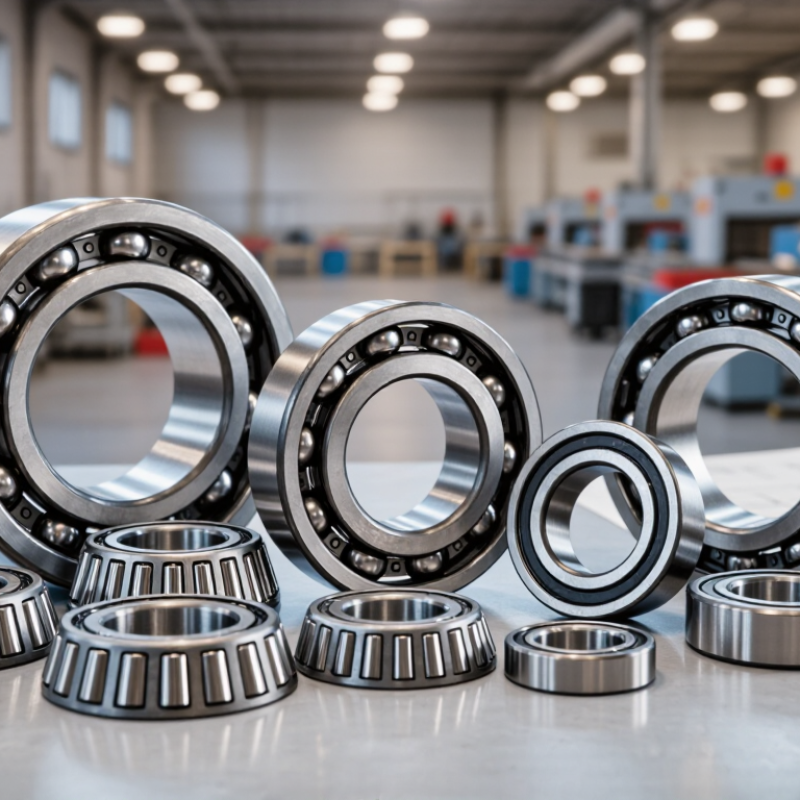
A deep-groove ball bearing suits many steady radial loads and moderate axial loads. Tapered roller bearings handle heavier combined loads, but they need correct adjustment. Spherical roller bearings tolerate shaft misalignment better. The application decides.
Internal design often changes service life more than buyers expect.
Choose internal clearance according to temperature, interference fits, and operating speed. Excessive clearance may create vibration and uneven contact. Too little clearance can cause heat, seizure, or early fatigue.
Cage material, rolling-element size, and raceway geometry also affect noise and friction. Seals protect against dust and moisture, while shields reduce contact resistance.
I have seen selection mistakes begin with a catalogue load rating alone. That number is only one piece.
Review actual duty cycles, shock loads, lubrication intervals, and mounting accuracy. A first estimate can be wrong. Ask for dimensional drawings, tolerance data, material certificates, and documented test results.
Confirm whether the bearing operates continuously or in short cycles. Check the shaft and housing together, not separately.
In humid workshops, a sealed design may outperform an open bearing, even when its friction is slightly higher. Temperature changes can also alter clearance, so thermal calculations deserve careful attention.
Reliable suppliers should explain their assumptions, not merely quote a part number.
Bearing selection begins with the real load, not the catalog’s largest rating. Separate radial, axial, shock, and moment loads before comparing designs. A higher load rating may reduce speed capability or increase friction. That trade-off is easy to miss. Use ISO 76 and ISO 281 methods when estimating static safety and rating life. However, calculated life is not a guarantee. Contamination, poor alignment, and installation errors can change actual results.
Speed requires more than checking revolutions per minute. Consider heat generation, lubrication viscosity, cage design, and operating temperature. Low-friction seals can reduce energy loss, but they may offer less protection in dusty environments. Choose clearance after reviewing shaft fits, housing tolerances, and temperature changes. Small errors matter. In global applications, verify grease compatibility and storage conditions across different climates.
Service life improves when the bearing matches the machine’s duty cycle. Inspect mounting surfaces, control preload carefully, and avoid forcing loads through the rolling elements. Ceramic or hybrid options may suit extreme speed, but they are not automatically better for every application. Cost, replacement access, and maintenance skills also affect reliability. A design that looks efficient on paper may disappoint in the field. Recheck the assumptions with operating data, especially when vibration, moisture, or frequent starts are present.
For global bearing buyers, material selection should match load, temperature, moisture, and installation quality. Through field inspections, I have seen ordinary steel outperform premium materials when storage and lubrication were controlled. Hardened bearing steel suits most industrial loads. Stainless steel helps resist humidity, but it may sacrifice some load capacity. Ceramic rolling elements reduce electrical damage risks, though their cost and brittleness need careful review. ISO 281:2007 defines L10 life as the point where 90% of identical bearings are expected to survive. That figure is statistical, not guaranteed.
Seals deserve equal attention. Contact seals block dust and water better, while non-contact shields usually reduce friction at higher speeds. Specify the real environment, not an ideal one. Grease selection should cover base oil viscosity, thickener compatibility, relubrication intervals, and the lowest starting temperature. The U.S. Department of Energy’s Operations & Maintenance Best Practices Guide identifies contamination control and correct lubrication as core reliability practices. Small errors matter. One overfilled housing can create heat. ISO 15243:2017 links many visible damage patterns with contamination, poor lubrication, and mounting errors. Operating tolerance also needs discipline: excessive internal clearance can increase vibration, while insufficient clearance can cause heat and seizure. ISO 281 life calculations cannot compensate for incorrect fits. A practical specification should state shaft and housing tolerances, temperature range, speed, axial load, seal type, and cleanliness target. I would also question every “maintenance-free” claim; site dust, washdown cycles, and operator habits often invalidate it.
| No. | Design Area | Recommended Specification | Technical Guidance | Buyer Verification Checklist |
|---|---|---|---|---|
| 1 | Select the Bearing Material | Use through-hardened bearing steel for general industrial duty. Consider corrosion-resistant stainless steel for moisture exposure, or hybrid ceramic rolling elements for electrical-current or high-speed applications. | Standard bearing steel generally provides high hardness, fatigue strength, and load capacity. Stainless steel improves corrosion resistance but may have different load and hardness characteristics. Ceramic rolling elements can reduce density and electrical conductivity, but the complete bearing design must still be checked for load, shock, and cost. | Confirm material designation, hardness range, corrosion requirements, operating temperature, load rating, and compliance with the required dimensional and performance standards. |
| 2 | Match the Seal or Shield to the Environment | Choose open bearings for systems with external lubrication and clean protection. Use shields for low-friction dust protection, and contact seals where water, dust, or lubricant retention is more important than maximum speed. | Contact seals normally provide better contamination protection but create more friction and heat than shields or non-contact seals. Seal material must be compatible with the lubricant, chemicals, temperature, and expected speed. | Specify seal type, seal material, ingress exposure, washdown conditions, allowable friction torque, temperature range, and whether relubrication is required. |
| 3 | Define the Lubrication System | Specify grease or oil according to speed, load, temperature, contamination, and maintenance access. For grease, state base oil type, thickener type, viscosity, consistency grade, fill quantity, and relubrication interval. | Grease is often selected for simpler maintenance and sealing. Oil can provide better heat removal and may suit high-speed or continuously lubricated systems. Do not mix greases unless their thickener and base-oil compatibility has been verified. | Check operating temperature, rotational speed, load, lubricant compatibility, oil viscosity, grease consistency, fill percentage, storage life, and the required relubrication procedure. |
| 4 | Specify Internal Operating Clearance | Use normal radial internal clearance for ordinary conditions. Consider increased clearance, such as a C3-class option, when shaft or housing interference fits, elevated temperature, or significant thermal expansion will reduce the running clearance. | Excessive clearance can increase vibration and reduce load distribution, while insufficient clearance can cause overheating, seizure, and premature failure. The final running clearance depends on bearing clearance, fits, temperature, and elastic deformation. | Provide shaft and housing dimensions, fit classes, temperature differences, expected interference, load direction, and the required radial internal clearance class. |
| 5 | Choose Accuracy and Tolerance Grades | Use the normal dimensional accuracy class for general machinery. Specify tighter accuracy classes only when runout, vibration, positioning accuracy, or high-speed stability requires them. | Tighter manufacturing tolerances can improve running accuracy but may increase cost and impose stricter requirements on shafts, housings, cleanliness, and assembly. Dimensional accuracy and internal clearance are separate specifications. | State the required accuracy grade, radial and axial runout limits, bore and outside-diameter tolerances, shaft and housing tolerance zones, and applicable ISO dimensional standards. |
| 6 | Calculate Load, Speed, and Bearing Life | Select the bearing from equivalent dynamic load, static load, rotational speed, required reliability, and expected operating hours. Use the basic rating life method as an initial calculation and validate the application-specific conditions. | Bearing rating life is commonly calculated from dynamic load rating and equivalent dynamic load. Static safety must also be checked for heavy stationary loads, shock loads, or low-speed oscillation. Contamination and lubrication can substantially reduce practical service life. | Submit radial and axial loads, load direction, shock factor, speed range, duty cycle, target service hours, ambient temperature, contamination level, and required reliability. |
| 7 | Control Installation and Global Supply Requirements | Define metric or inch dimensions, mounting orientation, fits, inspection requirements, packaging, traceability, storage conditions, and documentation before placing an international order. | Incorrect mounting force, shaft misalignment, contamination, or poor storage can damage a correctly specified bearing. Bearings should be handled cleanly, protected from moisture, and installed using the correct force path and tools. | Confirm dimensional system, drawing revision, inspection reports, material certificates, lot traceability, packaging method, shelf-life information, installation instructions, and applicable international standards. |
| Engineering note: Recommended specifications are general design starting points. Final bearing selection should be validated using the actual load spectrum, speed, temperature, fits, lubrication, contamination level, and required service life. | ||||