Heavy-duty machinery depends on components that remain steady under pressure, vibration, and repeated rotation. An Industrial Turntable Bearing supports this movement while carrying substantial radial, axial, or combined loads. In practice, performance depends on more than rated capacity. Load direction, rotation speed, mounting accuracy, lubrication, and operating temperature all influence service life. A bearing that performs well inside a clean factory may struggle near dust, moisture, or abrasive particles.
This guide examines 10 best industrial turntable bearings for heavy duty use. Each option should be judged by measurable engineering details, not attractive product claims. We consider load ratings, gear design, sealing methods, materials, backlash control, grease access, and installation requirements. Supplier documentation also matters. Reliable manufacturers usually provide dimensional drawings, tolerance data, testing information, and technical support.
Real applications are rarely perfect.
Welded frames can introduce distortion. Installation crews may overlook uneven bolt torque. Maintenance schedules can also fail during busy production periods. These practical weaknesses deserve attention because they often shorten bearing life faster than expected. No ranking can suit every machine, and that is worth acknowledging. A compact slewing ring may fit a robotic platform, while a larger cross-roller design may better support a precise inspection table. Buyers should verify calculations with qualified engineers and compare actual operating conditions against manufacturer specifications. The strongest choice is not always the largest or most expensive bearing. It is the design that matches the machine’s load, environment, accuracy, and maintenance reality.
Industrial turntable bearings support rotating platforms while carrying axial, radial, and tilting loads. Unlike simple wheel bearings, they often use large raceways and multiple rolling elements. Their broad diameter spreads force across a wider contact area. This design suits lifting tables, welding positioners, indexing systems, and heavy material handlers. In practical terms, the bearing is the hidden joint between a fixed frame and a moving platform. It must rotate smoothly, even when the platform is unevenly loaded. Small alignment errors can become visible as vibration, noise, or rising drive torque.
Heavy-duty use changes the selection process. Engineers must examine static load, working speed, overturning moment, shock, duty cycle, and mounting stiffness. A bearing may carry a heavy load slowly but fail under repeated impacts.
I have seen inspection teams blame the gearbox when grease loss and loose bolts caused the real problem. Dust wins. Seals, lubrication paths, bolt tightening, and raceway hardness deserve equal attention. Environmental temperature also matters, especially near furnaces or outdoor equipment. Load charts help, but they cannot replace measurements from the actual machine.
A reliable evaluation includes checking runout, backlash, temperature, noise, and bolt condition during operation. Operators should record changes rather than trust a single test. The best bearing is not always the largest one. Oversizing can increase cost, friction, and installation demands. I would also question a perfect design calculation, because real platforms rarely load evenly. Maintenance access and downtime risk should remain visible on the specification sheet.
How to Define Heavy-Duty Turntable Bearing Requirements
A heavy-duty turntable bearing starts with real operating conditions, not a catalog load rating. Measure vertical load, radial load, overturning moment, rotation speed, and duty cycle. A slow platform may still create severe stress during sudden starts or uneven loading. Record the heaviest working load, including tools, fixtures, and people-approved equipment. Then add a documented safety margin. Guessing here is costly.
Tips: Sketch the load path before choosing the bearing. Mark where the force acts and how far it sits from the center. This distance controls the overturning moment. Check mounting plate stiffness, bolt spacing, shaft alignment, and housing flatness. A strong bearing can perform poorly on a flexible structure. I have seen this overlooked during installation.
Environmental details matter just as much. Dust, water spray, heat, chemicals, and outdoor temperature changes affect seals and lubricant selection. Specify the required rotation angle, indexing accuracy, vibration level, and expected service hours. Gear teeth may be useful, but they also require proper backlash and protection. Inspect the application after trial operation, especially if noise or uneven torque appears. The first calculation may be wrong. Revise it using measured data, not optimism.
Ten Top Industrial Turntable Bearings for Demanding Applications
Choosing the right industrial turntable bearing depends on load direction, rotation speed, shock, and mounting space. A perfect ranking is impossible. Application details change everything.
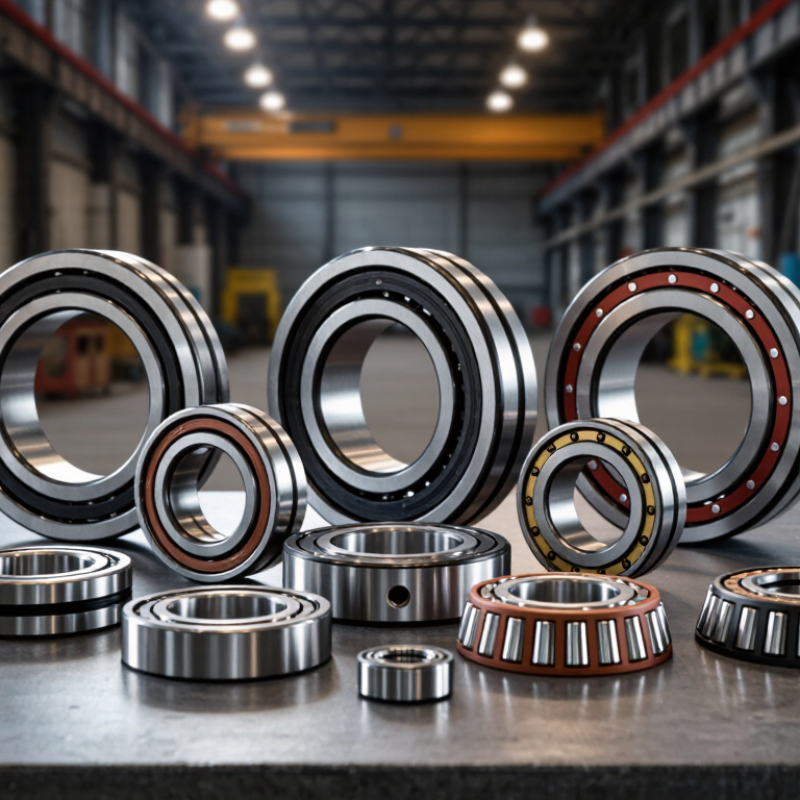
Four-point contact ball bearings suit moderate loads and compact turntables. Crossed roller bearings offer high stiffness with limited deflection. Double-row ball bearings handle radial loads and overturning moments efficiently. Three-row roller bearings support very heavy loads at slower speeds. Tapered roller bearings manage combined radial and axial forces. Cylindrical roller bearings provide strong radial capacity and stable operation. Spherical roller bearings tolerate slight shaft or frame misalignment. Flange-mounted bearings simplify installation where housing space is restricted. Slewing ring bearings fit large platforms, indexing tables, and lifting equipment. Plain composite bearings work quietly in low-speed, maintenance-sensitive systems.
Real performance depends on more than catalog capacity. Engineers should check static safety factors, moment loads, bolt strength, raceway hardness, lubrication intervals, and sealing quality. Dust can enter through a small gap. Poor mounting can create uneven raceway stress. That mistake is common.
During inspection, measure backlash, noise, temperature, and rotation resistance. Use measured loads instead of optimistic estimates. In demanding environments, a slightly oversized bearing may reduce wear, but excessive preload can increase heat. The best selection balances stiffness, service life, maintenance access, and actual operating conditions.
| Rank | Bearing Type | Typical Construction | Typical Outside Diameter | Typical Bore / Mounting Diameter | Typical Static Axial Capacity | Typical Radial Capacity | Approx. Speed Range | Best Suited Applications | Key Selection Advantage |
|---|---|---|---|---|---|---|---|---|---|
| 1 | Four-Point Contact Ball Slewing Bearing | Single-row raceway with four-point ball contact | 250–3,000 mm | 150–2,800 mm | 0.2–25 MN | 0.1–12 MN | 0.5–20 rpm | Cranes, excavators, positioning platforms, lifting equipment | Handles combined axial, radial, and overturning loads in a compact arrangement |
| 2 | Double-Row Ball Slewing Bearing | Two ball rows with separated load paths | 400–4,500 mm | 250–4,200 mm | 0.8–60 MN | 0.3–30 MN | 0.2–12 rpm | Heavy cranes, material handlers, large rotary machinery | Higher load capacity and improved moment resistance than a single-row design |
| 3 | Crossed-Roller Turntable Bearing | Alternating cylindrical rollers arranged at 90 degrees | 80–1,500 mm | 40–1,300 mm | 20 kN–2.5 MN | 10 kN–1.2 MN | 10–300 rpm | Robotic positioners, inspection systems, machine tools, precision rotary tables | High rotational stiffness, low runout, and excellent moment-load resistance |
| 4 | Three-Row Roller Slewing Bearing | Separate axial, radial, and moment-load roller raceways | 500–6,500 mm | 300–6,100 mm | 2–150 MN | 1–100 MN | 0.1–8 rpm | Mining equipment, ship loaders, large cranes, tunnel machinery | Maximum load-carrying capability for very large, slow-moving structures |
| 5 | Tapered-Roller Turntable Bearing | Tapered rollers carrying axial and radial loads | 150–2,000 mm | 75–1,800 mm | 50 kN–8 MN | 30 kN–4 MN | 5–150 rpm | Industrial gear drives, wheel assemblies, heavy rotary fixtures | Excellent combined-load performance and adjustable internal clearance |
| 6 | Cylindrical-Roller Thrust Turntable Bearing | Axial cylindrical rollers with separate radial guidance | 100–1,200 mm | 50–1,050 mm | 30 kN–5 MN | 10 kN–1.5 MN | 5–120 rpm | Heavy indexing tables, presses, vertical rotary equipment | Very high axial capacity with strong shock-load tolerance |
| 7 | Double-Row Angular-Contact Ball Bearing | Two matched angular-contact ball rows | 80–800 mm | 40–650 mm | 10 kN–800 kN | 8 kN–350 kN | 50–1,000 rpm | Moderate-duty rotary tables, packaging machinery, automation equipment | Good precision and speed where loads are high but not extreme |
| 8 | Spherical-Roller Thrust Turntable Bearing | Spherical rollers with self-aligning raceway geometry | 120–1,000 mm | 60–850 mm | 40 kN–4 MN | 15 kN–1.2 MN | 2–80 rpm | Industrial gearboxes, vertical shafts, heavy process equipment | Accommodates shaft misalignment while carrying substantial axial loads |
| 9 | Wire-Race Turntable Bearing | Hardened raceway wires supported by concentric rings | 100–2,000 mm | 60–1,800 mm | 10 kN–1.5 MN | 5 kN–600 kN | 10–250 rpm | Large-diameter scanners, radar systems, cleanroom equipment, precision stages | Low cross-section, customizable geometry, and reduced rotating mass |
| 10 | Plain Slewing Ring with Sliding Surfaces | Metal-polymer or metal-lined sliding raceway | 100–2,500 mm | 50–2,300 mm | 20 kN–3 MN | 10 kN–1 MN | 0.1–30 rpm | Outdoor machinery, agricultural equipment, low-speed indexing platforms | Low maintenance, contamination tolerance, and suitability for oscillating motion |
Choosing an industrial turntable bearing starts with the actual load path, not the catalogue headline. Separate radial, axial, and overturning moments. ISO 76 uses static load ratings to assess permanent deformation risk, while ISO 281 calculates dynamic rating life. Its L10 rating represents a 90% reliability target under defined conditions. That is useful, but not a guarantee. Shock loads, misalignment, and poor lubrication can reduce life sharply.
Accuracy needs equal attention. ISO 492 and ISO 199 classify dimensional and running tolerances for rolling bearings. For a robotic fixture, even a small axial runout can become visible at the tool tip. Measure runout under the real mounting preload. A clean laboratory result may not survive a welded frame. This is where many comparisons become unrealistic. Higher precision also demands better machining, mounting, and inspection discipline.
Sealing should match the environment, not simply look thicker. IEC 60529 defines IP protection tests, including dust and water exposure, but an IP rating does not describe grease retention or bearing fatigue life. In a dusty conveyor area, inspect the seal lip, grease purge path, and contamination marks after each service cycle. Durability depends on load spectrum, temperature, lubrication, hardness, and installation torque. Use the manufacturer’s load curves, then verify them against ISO calculations and site measurements. A conservative safety factor is sensible, though excessive sizing can hide alignment problems and increase starting torque. The better choice balances capacity, accuracy, sealing, and service evidence.
10 Best Industrial Turntable Bearings for Heavy Duty Use?
Selecting, installing, and maintaining a turntable bearing requires more than checking its diameter. Match the bearing to radial load, axial load, overturning moment, speed, and duty cycle. Measure twice. Small errors matter.
Review static and dynamic load ratings against real operating conditions. Include shock loads from sudden stops or uneven material. Check mounting bolt size, pitch circle, clearance, allowable tilt, and required rotation accuracy. In practice, my first load estimate is rarely perfect. Verify calculations with engineering data and the bearing manufacturer’s technical drawings.
Installation starts with clean, flat mounting surfaces. Remove burrs, paint flakes, and trapped debris. Position the bearing carefully, then tighten bolts in a cross pattern using a calibrated torque wrench. Do not force misaligned parts into place. Rotate the assembly slowly and check for binding, unusual noise, or excessive runout. A brief test under no load can reveal mistakes early.
Maintenance should follow operating conditions, not only calendar dates. Inspect bolt torque, seals, gear teeth, raceways, temperature, and vibration. Apply compatible grease in the recommended quantity. Too little grease accelerates wear, while too much can raise operating temperature. Record readings during each inspection. I have found that simple records often expose gradual problems before failure. Still, inspection routines can miss hidden damage, so unusual resistance or vibration deserves professional assessment.